

Stop Mediating Conflicts
Why stepping in feels like leadership. And why it quietly breaks execution.

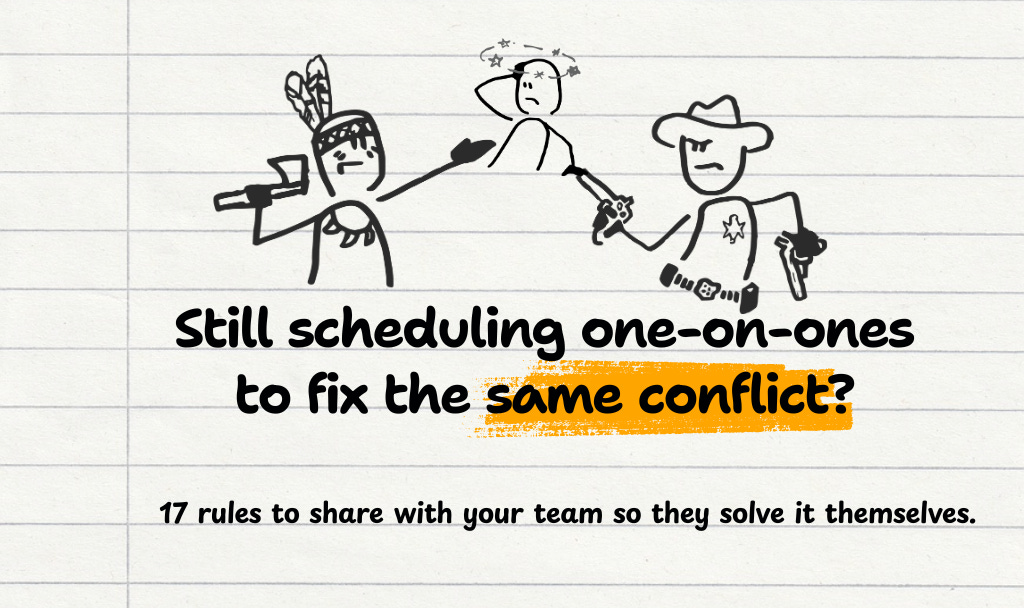
This keeps happening for a reason.
Two people on your team don’t get along. They sit in different teams, with different priorities and shared dependencies. You know it. They know it.
For months, you’ve been doing the same thing. Listening. Mediating. Asking them to “work it out.” Scheduling one-on-ones. Facilitating conversations. Playing referee.
You stepped in because you care about the work continuing. That part matters.
What you’re dealing with isn’t a relationship issue. It’s a cross-team systems problem being handled like a feelings problem.
Before we dive in, a quick note.
I am building Wisemove to help founders step out of day-to-day execution. Every week, I share frameworks that create clarity without adding complexity—no theory, just what worked when we helped a technology team move their Glassdoor rating from 2.7 to 3.9.
If your team depends on you for everything, this is for you.
If this sounds familiar, I’m curious how it usually shows up for you.
No matter which option you picked, there’s a common pattern underneath it.
You hired adults. Why are you still mediating?
Meetings, follow-ups, side conversations, and venting sessions pile up faster than you expect. What feels like “handling it” turns into a recurring tax on your attention.
Most leaders don’t do this intentionally. They step in because it feels responsible in the moment. Listening. Facilitating. Keeping the peace.
Good leaders don’t spend energy smoothing friction. They remove the reasons friction keeps showing up.
They don’t mediate personality clashes.
They eliminate the conditions that make personality matter more than performance.
The real problem isn’t them. It’s you.
You think the issue is that two people have different communication styles. In reality, you never defined what working together actually requires. Without clear expectations, every interaction turns into interpretation.
You think the problem is that they need to build rapport. The real issue is that their responsibilities overlap across teams and no one owns the handoff. When ownership is unclear, friction is inevitable.
You think one of them is difficult. What’s actually happening is inconsistency. You tolerate behaviour in one person that you punish in another, and everyone sees it.
This isn’t a relationship issue. It’s a structure issue. And structure problems don’t get solved through empathy. They get solved through clarity.
Here’s what actually works.
You don’t need another conversation or a better way to “create space for dialogue.” More talking won’t fix a system that was never defined.
What your team needs are operating instructions. Clear rules for how work moves across teams, especially when people don’t like each other.
Not therapy. Not bonding exercises. Just standards that make expectations obvious and behaviour predictable.
You don’t need your team to like each other. You need them to deliver together. And when the structure is right, they will.
17 Rules for Working Through Cross-Team Conflict
Share these with anyone on your team struggling with cross-team friction.
Treat these as operating rules.
If something blocks the work, raise it. Otherwise, follow the rules.
PART 1: Reset the Foundation
1. Stop trying to “clear the air.”
That conversation you think will fix things? It won’t.
It’ll just formalize the tension.
Start with clean behaviour, not a clean slate.
2. Never ask “Can we talk?”
That phrase creates dread and puts them on defence.
Just say what you need. No build-up.
Direct requests show respect, not hostility.
3. Stop saying “we” when you mean “you.”
“We need to get this done” is passive-aggressive.
If it’s their job, say “This is needed by Friday.”
Clarity removes drama. Vagueness creates it.
4. Anchor the conversation in the work.
Talk through the work, not about each other.
Point to the document, the deadline, the client email.
Let the work carry the message.
This removes ego from the exchange.
PART 2: Lower the Temperature
5. Share outcomes and constraints. Skip opinions.
Over-explaining decisions creates debate, not alignment.
State the outcome required and the constraints to work within.
Leave reasoning out of it.
Trust across teams rebuilds through delivery, not justification.
6. Choose outcomes over correctness.
Choose your interventions based on impact, not principle.
If their “wrong” way still gets the outcome, let it go.
Winning every argument breaks relationships. Choose progress over proof.
7. Never defend yourself in the moment.
If they criticize you in a meeting, let it sit.
Respond later with facts, not feelings.
Immediate defence escalates conflict. Facts bring it back to work.
8. Assume uneven days and plan for them.
People are inconsistent on bad days.
Plan for the worst day, not the average one.
Build systems that absorb variance. Don’t depend on best behaviour.
PART 3: Rebuild Through Action
9. Define shared work where the outcome is visible.
If the work requires constant coordination, don’t split it into invisible pieces.
Define a joint output both sides contribute to.
Let the result speak, not status updates.
Trust across teams grows when delivery is visible and shared.
10. Ask them one question you’ve never asked before.
“What would make this easier for you?”
“What part of this process wastes your time?”
Curiosity is a reset button. It signals you see them as a person, not a problem.
11. Acknowledge when they deliver.
You don’t need to praise them warmly.
But if they did good work, say it clearly.
“This was solid” costs you nothing. Silence costs trust.
PART 4: Build Sustainable Collaboration
12. Stop managing their opinion of you.
The moment you stop managing how you’re perceived, the work gets cleaner.
Indifference to approval creates space for real collaboration.
13. Find one shared problem both teams want gone.
A shared enemy builds better alignment than forced friendship.
Identify the obstacle: rework, delays, client confusion, unclear priorities.
Work together against that. Not against each other.
14. Separate performance from personality.
You don’t need to like how they think to respect what they produce.
Judge the work, not the person.
This is the foundation of professional respect.
15. Set a boundary, then honour it.
If something they do truly blocks progress, name it once.
Don’t repeat. Don’t nag. Don’t hint.
Say it clearly: “This behaviour delays the team. It needs to stop.”
Then move forward. Boundaries respected build trust.
16. Let time do the work emotions can’t.
Some trust rebuilds slowly, through repeated neutral exchanges.
You don’t need a breakthrough moment.
You need 20 interactions where nothing goes wrong.
17. Accept that respect doesn’t require warmth.
You’re building a team, not a family.
Professional respect is enough.
If the work moves and standards hold, you’ve succeeded.
The new standard.
If your team can’t work through interpersonal friction with these rules, the problem isn’t them.
It’s your structure. You’ve built a company where personality matters more than performance.
Where vague roles create constant conflict and where people need you to translate every interaction.
That’s not a people problem. That’s a design problem.
And it’s on you to fix it.
Stop mediating. Start designing.
PS: If you found yourself getting defensive while reading this, good.
That’s the point.
This isn’t supposed to make you feel comfortable.
It’s supposed to make you realize what you’ve been tolerating.
Share this with a founder who’s stuck in the same pattern.
Not because they’ll thank you.
Because they need to hear it.
Was this helpful? 🧡
If this resonated with you, share it with a founder who’s stuck firefighting. We all grow when someone names what we’re quietly struggling with.
P.P.S. – Join the conversation. I read every comment and reply to founders working through these patterns in real time.
