

Why Execution Keeps Routing Back to Founders as Teams Grow
The four things that must align before your team can run without you

You built your business over years. It survived. It grew. Revenue is decent. From the outside, everything looks stable.
But you know the truth.
The business runs only because you are always involved. Client escalations come to you. Budget decisions wait for you. Priority questions land on your desk. When deadlines slip, you step in.
You are not managing the business anymore. You are holding it together.
This is not what you signed up for. You wanted growth. You wanted a team that could execute. But somehow, as the team grew, so did your involvement. More people did not mean less dependency. It meant more.
And you are exhausted. Not from the work itself. From being the answer to everything.
The Problem: Growth That Traps Instead of Frees
Here is the strange part. You did what you were supposed to do.
You hired good people. You bought tools to manage work better. You ran performance reviews. You sent people to training programs. You tried to delegate. You even set up processes.
And still, nothing moves unless you are involved.
Research shows this is not rare. According to a 2024 study, 42% of business owners have experienced burnout in the past month. Another survey found that 56% feel completely alone in solving problems.
You are not failing. You are stuck in a pattern that traps most businesses at a certain size.
When you had five people, everyone understood what mattered. Conversations were short. Adjustments happened quickly. At twenty people, understanding fragments. At fifty people, it disappears.
So people start asking you. What is the priority? What should we focus on? Should we do this or that?
You answer. Because if you do not, nothing happens.
You become the hub. Every decision flows through you. Every confusion gets escalated to you. You thought you were building a team. You were actually building a dependency system.
And tools do not fix this. You bought software to track work. Everything looks organized on the dashboard. But the team still asks what matters most. Because tools track activity. They do not define outcomes.
You hired experienced managers. They drift. They wait for direction. Not because they lack ability. Because roles were never clearly defined. Deloitte research reveals that only 30-40% of companies effectively align job titles and roles with the actual work being performed.
You formalized everything. Performance reviews. Standard operating procedures. Forms were filled. Meetings were held. Nothing changed.
Because process records confusion. It does not remove it.
The Real Cost
This creates damage that compounds quietly over time.
Your team learns to wait. When every decision requires your input, people stop thinking. You thought you were maintaining standards. You were training helplessness.
Your best people leave first. High performers do not stay in systems where ownership is unclear. Gallup research indicates that only 50% of employees strongly agree they know what is expected of them. You lose good people not to better salaries. You lose them to vague expectations.
Growth starts to feel dangerous instead of exciting. McKinsey found that 63% of technology startups fail within five years, with premature scaling or lack of a clear operating model being a major contributor. But this pattern happens in every industry where founders get stuck holding everything together.
Why Substitution Does Not Work
Over the years, you tried to fix this problem.
You spent money on productivity tools. Same confusion every Monday. You paid recruitment fees to hire seniors. They left within months. You invested in coaching sessions. One good week. Then back to chaos.
Each promised clarity. Each delivered activity. None removed the chaos.
This is what we call Substitution Leadership.
It is the belief that you can replace thinking with something you can buy. Instead of defining what success looks like, you buy tools. Instead of clarifying who owns what, you hire seniors. Instead of building structure, you motivate.
Substitution feels productive. You can see the invoice. You can track the activity.
But it never fixes the system.
Because the problem is that clarity cannot be bought. It has to be built.
The Same Page Framework
After working with founders stuck in daily execution, we saw a pattern.
The businesses that broke free from founder dependency did not add more tools. They did not hire more people.
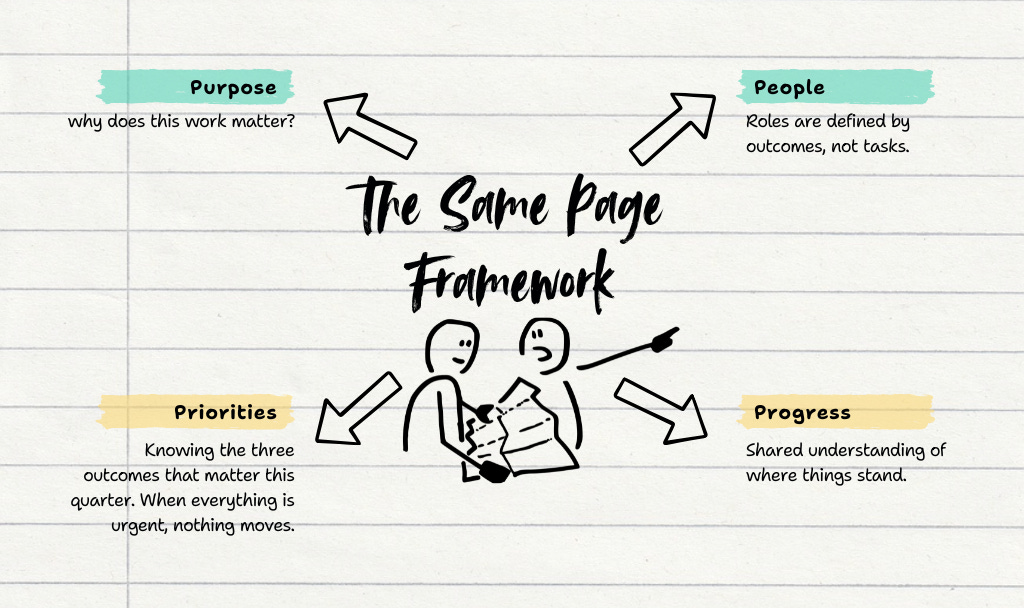
They aligned four things: Purpose. People. Priorities. Progress.
This is the Same Page Framework. If these four things are not aligned, the business will always struggle. If they are aligned, execution becomes simpler.
Purpose answers: why does this work matter? When purpose is clear, teams know what they are building toward.
People means roles are defined by outcomes, not tasks. Most role confusion comes from undefined decision rights. People do not know which decisions are theirs to make.
Priorities means knowing the three outcomes that matter this quarter. When everything is urgent, nothing moves.
Progress means shared understanding of where things stand. Progress without visibility creates false confidence.
Research on alignment shows that organizations with strong alignment achieve up to double the financial performance compared to misaligned organizations.
What Changes When These Align
When these four things align, something shifts.
Decisions happen without you. Your team stops waiting. Growth stops feeling risky.
Because new people join a system, not chaos. Because the structure scales even when you do not.
Where to Start
For one week, track every decision that waits for you. Ask why each decision needed you. Pick the pillar where confusion costs you most time. Define it clearly.
Alignment is not a one-time event. Alignment is a rhythm. But once the structure exists, maintaining it takes far less energy than firefighting without it.
Final Thought
The question is whether the business can grow without depending on you for everything.
The answer lies not in working harder. The answer lies in building a system that works without you at the center.
The Same Page Framework—Purpose, People, Priorities, Progress—is how businesses move from founder-dependent to system-driven.
Not through substitution. Through clarity.
If execution keeps routing back to you, it is not because your team lacks capability. It is because these four pillars are not aligned.
So which pillar is costing you the most right now?
Over the next few weeks, I will walk through how to diagnose and fix each one. Subscribe to follow along.